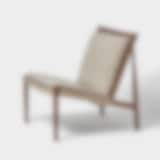
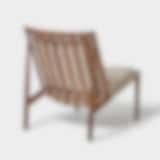
The Easy Chair was launched in 2016 but has already become a modern design classic – one of Norrgavel's most beloved pieces of furniture. A timeless armchair with a minimalist expression, where craftsmanship and seating comfort are pure perfection. The process of realizing the Easy Chair took several years of sketches, prototypes, and fine-tuning. To find inspiration for the Easy Chair, Norrgavel's founder and designer, Nirvan Richter, looked to Japan.
"The working name for the chair I longed for became Zazen – seated meditation."
"Sitting on the floor in Japanese houses is a special experience. No chair, more like being in nature, with refined simplicity – zen. A perfect sitting angle on a beautiful wooden frame, a saddle strap of linen supporting a seat cushion of horsehair and a back cushion of seabird feathers. Ascetic in its expression, but comfortable in its feel. You don't sit in a chair but in the space, as if floating in the air. Placing two next to each other is especially beautiful. Many of Norrgavel's furniture pieces have generic names, but what about this one? More than a chair, but "Armchair" is too stuffed... so we turned to English for help, and it became Easy Chair."
Nirvan Richter, designer
Unlike Western houses, which are often at their most beautiful before construction is "dressed up" with cladding and surface layers, the construction remains forever visible in the traditional Japanese house. The load-bearing framework is a skeleton on which the entire room design rests; between the wooden posts, there are fusuma (sliding doors with rice paper) and shoji (room dividers), and the floor is covered with tatami (rice straw mats). One sits or lies directly on the floor, with just a thin padded cushion or mattress as support.
The vision behind the Easy Chair is built on similar thoughts. The solid oak wooden frame is graphically clear – a simple sitting angle that is supported at the front by two vertical legs, with the seat's frame continuing backwards and meeting the rear legs in a stable truss structure – a stripped-down and forever visible construction, just like in the traditional Japanese house.
It is often said that all interior design is about creating a balance between open space and enclosed comfort. The Japanese house breathes openness while Western interiors often lean towards greater enclosure. The same dynamics exist in sitting itself; one sits on a chair, but in an armchair – and the Easy Chair falls somewhere in between.